The implementation of LPWA technology is growing rapidly along with the trend of internet of things (IoT) applications. This technology allows data collection over long range, so it is a perfect choice when data collection must be collected from very far areas. LoRaWAN technology, non-cellular LPWA, is also used in smart gas meter device to provide information of gas consumption volume in real time.
In this article we will discuss all about smart gas meter and its DJID certification requirements in Indonesia.
What is smart gas meter?
Smart gas meter is a measuring device used to measure gas consumption volume digitally and automatically in real time. The measurement will eliminate the need for manual measurement process and provides real time monitoring data to the users.
One of the main functions of smart gas meter is to provide accurate data on the volume of gas consumption by adopting a LoRaWAN technology. The measurement is also influenced by temperature, pressure, and heating conditions.
How smart gas meter works?
Smart gas meter works by using LoRaWAN technology to transmit the collected data wirelessly. The gas meter data is sent to a LoRaWAN gateway, and after that it will be sent to the server. The received data at the sever can be monitored in real time via an application or management platform.
LoRaWAN connectivity that operate in low power with long range capability is also the key of efficient remote operation. Smart gas meter rely on low voltage battery power to extend the operational life and avoid ignition hazards. This device works at a certain pressure and equipped with a keypad.
Smart gas meter adopts the most advanced LoRaWAN communication technique with the advantages of depth coverage network, wide link, and low power consumption. The communication of LoRaWAN technology is also stable, reliable, and secure.
Types of smart gas meter
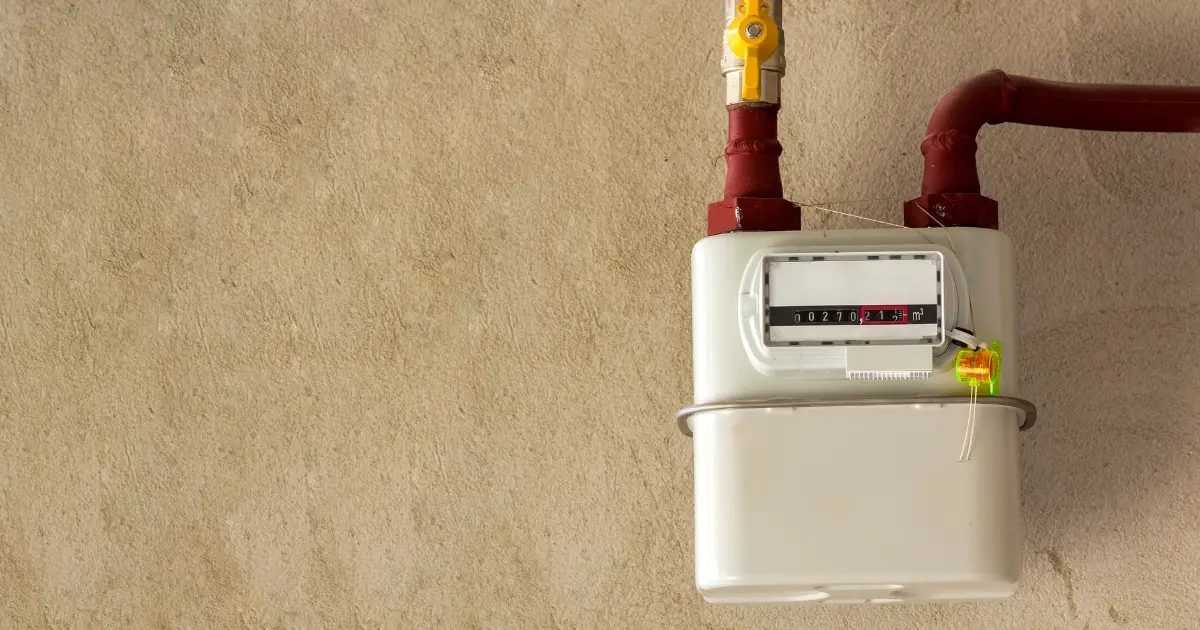
Here are three types of smart gas meter that possibly can be used in buildings and the users have to know.
Diaphragm gas meter
Diaphragm gas meter has 4 connected measuring chambers. The shape of this detector unit is also separated by a diaphragm and a deformed wall. The amount of gas passing through the diaphragm meter can be directly measured if the volume of each chamber is known.
Turbine gas meter
Turbine gas meter is a type of gas meter that can detect gas molecules that travel through the gas meter continuously. When the gas flows, the turbine will start to rotate and the rotation of the turbine wheel is also proportional to the speed of the gas flow.
Rotary displacement gas meter
Rotary displacement gas meter is a type of gas meter that has 2 rotating impellers that are placed facing each other in an apartment or house unit. The amount of gas can be detected directly if the volume of each chamber is known.
Benefits of smart gas meter
Here are three benefits of smart gas meter that the users have to know, especially when it being used in a an apartment or house unit.
Detecting flammable gas
The first function of a smart gas meter is to detect flammable gases. Sometimes users are less careful against some types of objects with potential flammable gases that possibly can cause fires.
By using a smart gas meter, users can prevent fires caused by the gases above. Because smart gas meter will detect the gas that causes the fire. So, users can know the concentration of gas in the room from the start and can be more careful.
Performing indoor oxygen depletion
Excess oxygen gas in a closed room can also be dangerous. When the oxygen pressure in a room is 1 bar higher than normal pressure, it can cause the air to become toxic.
This oxygen poisoning can also cause various vital diseases of the nervous system. In addition to detecting dangerous gases, smart gas meter is also useful for thinning excessive oxygen levels in a room.
Detecting toxic gas inside a room
Smart gas meter also can capture toxic substances or gases. Through the sensors available, this tool will be very easy to detect gases such as carbon monoxide, hydrocarbons, etc. So, this tool is very important for peoples who live in apartments with factory environments around them.
DJID certification for smart gas meter
As mentioned earlier, smart gas meter will requires LoRaWAN connectivity to transmit the gas meter data to the gateway. That is why, smart gas meter equipped with LoRaWAN feature is categorized as telecommunications devices.
Smart gas meter should meet applicable technical standards before being marketed in Indonesia. The fulfillment of technical requirements is carried out through a product certification process called DJID certification.
By processing the DJID certification, it indicates that the product has been marketed legally in Indonesia. In addition, DJID certificate also ensures that the smart gas meter already worked in the permitted frequency bands in Indonesia, so it will not cause any interference during its operation.
Before processing the DJID certification, it is necessary to perform RF and EMC test for smart gas meter. The RF and EMC test reports will be used for the DJID certification.
RF test for smart gas meter
Smart gas meter use LoRaWAN connectivity during its operation and the supporting frequency band for is usually 920 MHz. The testing of smart gas meter is conducted based on the technical regulation of KEPMEN KOMINFO No. 5 year 2024. Below is the mandatory testing parameters for LoRaWAN feature.
| Frequency range | Output power | Bandwidth | Duty cycle | Spurious emission |
| 920 – 923 MHz | End Node: < 100 mWatt EIRP, Gateway: < 400 mWatt EIRP | < 250 kHz | Uplink < 1%, Downlink < 1 % | ETSI EN 300 220-1, ETSI EN 300 328 |
Smart gas meter will be categorized as end node during the LoRoWAN testing process. The testing challenges for LoRaWAN is usually lies on the duty cycle requirement. Duty cycle testing requirements on LoRaWAN are related to the time constraints of radio signal transmission for LoRaWAN devices.
EMC test for smart gas meter
Smart gas meter is commonly supplied by non-rechargeable battery like AA batteries. Therefore, the required EMC test for smart gas meter is EMC radiated emission only. The EMC test for DJID certification should be performed based on EMC standard of CISPR 32.
The testing of EMC radiated emission for smart gas meter is carried out in the frequency range of 30 – 1000 MHz for low frequency and 1000 – 6000 MHz for high frequency. When the test result graph of EMC radiated emission is still below the limit, then smart gas meter device has passed the EMC test requirement.
If you have any question related to DJID certification, please don’t hesitate to contact us by sending enquiry to info@narmadi.com.