Based on current regulations, various types of telecommunications and ICT devices are required to obtain type approval certificate before entering and being marketed in Japan. Therefore, it is important for manufacturers to understand the type approval certification process for telecommunications and ICT devices in Japan. In general, the type approval certification for telecommunications devices in Japan is managed under the Ministry of Internal Affairs and Communication or MIC. However, MIC does not issue the type approval certificate directly, they appoint Certification Body or CB to process and issue the type approval certificate.
Various types of telecommunications and ICT devices subject to technical standards establish by MIC. Broadly speaking, the type approval certification in Japan are commonly cover under the Radio Law and the Telecommunications Business Law. Both regulations commonly refer to type approval certification for radiocommunications and telecommunications devices in Japan.
In this article we will discuss all about Japan MIC certifications process especially for telecommunication and ICT devices need to be marketed in Japan.
Type Approval Certification in Japan
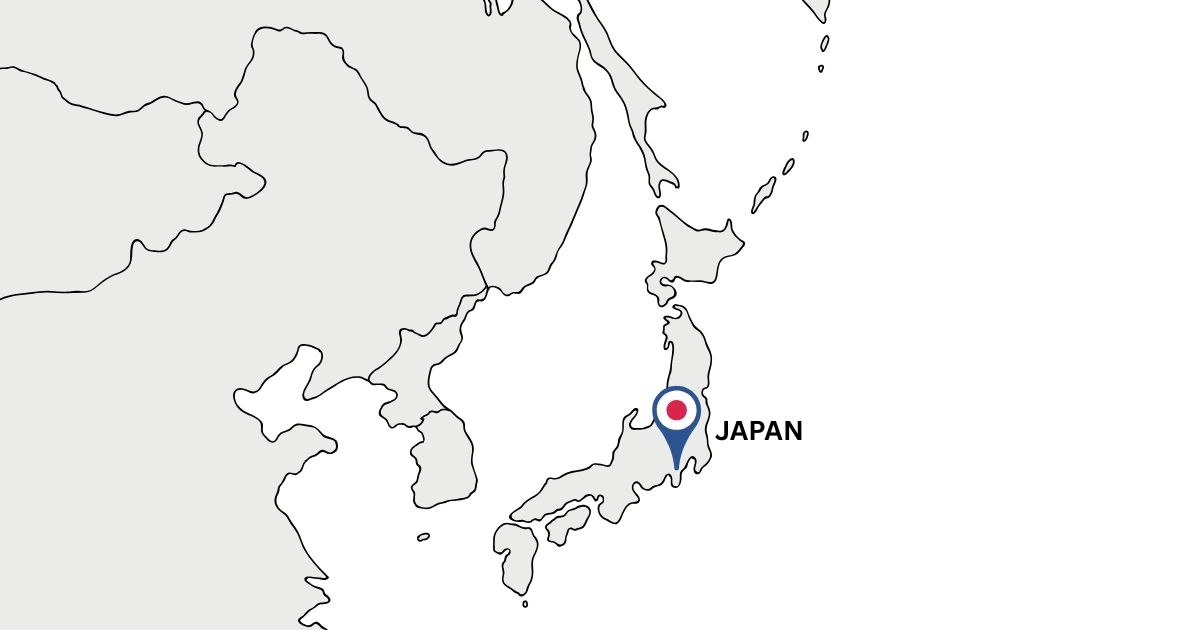
Before manufacturers importing their telecommunications devices to Japan, they need to prepare type approval certification of their telecommunications devices first. In Japan, the type approval certification for telecommunications and ICT devices is managed by the Ministry of Internal Affairs and Communication (MIC). However, MIC appoints several Certification Bodies (CB) to process and issue the type approval certificate. MIC will keep responsible for the radio and telecommunications network management in Japan, include establish the technical standards for radio and telecom equipment.
In general, the type approval certification for telecommunications and ICT devices in Japan divided into two broad equipment categories, which are radio equipment regulated under the Radio Law and terminal equipment regulated under the Telecommunications Business Law. Both the Radio Law and the Telecommunications Business Law commonly refer to MIC certification in Japan.
Radio Law regulates all type of telecommunications and ICT devices that emit radio frequency waves under 3 THz. Type of equipment that covered under the Radio Law is not only wireless devices, but also high-frequency equipment. Therefore, telecommunications and ICT devices under the Radio Law are classified to several classification, as follows:
- Specified Radio Equipment (SRE) and Special Specified Radio Equipment (SSRE): Bluetooth, WiFi, Zigbee, Wireless Mic and UWB.
- High-Frequency Device (HFD): IH cooking devices, Microwaves, RFID devices (13.56 MHz) and PLCs.
- Extremely Low-Power Device (ELP): Devices operate in specific frequency and maximum emission, which are < 322 MHz and < 500 µV/m; 322 MHz – 10 GHz and < 35 µV/m; and 10 GHz – 150 GHz and < 3.5x µV/m or 500 µV/m.
Telecommunications Business Law regulates all type of telecommunications equipment that connect to public network in Japan. Following are several types of telecommunications equipment covered under the Telecommunications Business Law:
- Telephones to be connected to the equipment for analog telephones or mobile phones, private branch exchange equipment, button telephones, modems, facsimile equipment, and other terminal equipment.
- Telephones to be connected to the equipment for Internet protocol phones, private branch exchange equipment, button telephones, code converters, facsimile equipment, and other terminal equipment for control.
- Terminal equipment to be connected to Internet Protocol Mobile Telephone Facilities.
- Terminal equipment to be connected to the equipment for integrated digital communication.
- Terminal equipment to be connected to the private communication line equipment.
Requirements of MIC Certification
Before processing MIC certification, manufacturers or importers need to do local testing of their devices first. Mostly, the testing for Japan type approval is conducted at test lab owned by designated Certification Bodies (CB).
For the radio frequency measurement, test samples of radio equipment will be connected by coaxial cables to perform a radio test because some testing will not be held in anechoic chamber. Here is list of the required documents for MIC certification under local testing method:
- Application form specified by designated CB
- Block diagram of the whole system and radio part
- Schematics/circuit diagram of the radio part
- Component list/BOM of the radio part
- Transmission data rate
- Antenna peak gain specifications (unit in dBi)
- Test reports (not mandatory)
- Dimension diagram
- Parts layout
- Photographs of the equipment
- User manual
- RF chipset specifications
For equipment under Specified Radio Equipment (SRE) category, manufacturers or importers can process MIC certification through Type Certification or Batch Certification. SRE Type Certification applicable for mass-produced products and using a representative sample for testing. Meanwhile SRE Batch Certification applicable for small batch-produced products.
For equipment under High Frequency Device (HFD) category, beside the test reports manufacturers or importers also need to submit 3 type of DoCs, which are specification of type, confirmation of type, and authorization for use. For equipment under Extremely Low-Power Device (ELP), manufacturers or importers need to submit test reports under the ELP mark scheme.
Applicants of MIC Certification
Applications of MIC certification both under Radio Law and Telecommunications Business Law must be submitted by a local Japanese company. The Japanese companies may act as manufacturers, importers or suppliers of telecommunications and ICT devices in Japan. Foreign companies need to set up a Japanese company may act as a local importer or supplier if they want to process MIC certification in Japan.
Lead time of MIC Certification
Lead time of MIC certification under Radio Law and/or Telecommunications Business Law may vary depend on the product features. Besides, the lead time of MIC certification also depends on the availability of the lab and how fast the client can prepare all the samples and documents needed.
For instance, for a Bluetooth device, if there is no issue on the sample and complete documents, normally the testing and certification can be completed within 1-2 week. Meanwhile, for a device with more features and limited availability of testing lab schedule, it may provide longer lead time for testing and certification around 4-5 weeks.
Label Requirements of MIC Certification
There are several types of label requirement that need to be complied by manufacturers or importers after completing the MIC certification process. The label requirements for a type approved equipment will depend on its classification: SRE, Terminal, HFD, or ELP.
Equipment under Specified Radio Equipment (SRE) and Terminal Equipment categories will require to comply with GITEKI mark requirements. There are two types of GITEKI marks, the GITEKI mark with “R” for radio equipment and GITEKI mark with “T” for terminal equipment. The size of GITEKI mark is not specified by MIC Office, but it must be easily identified.
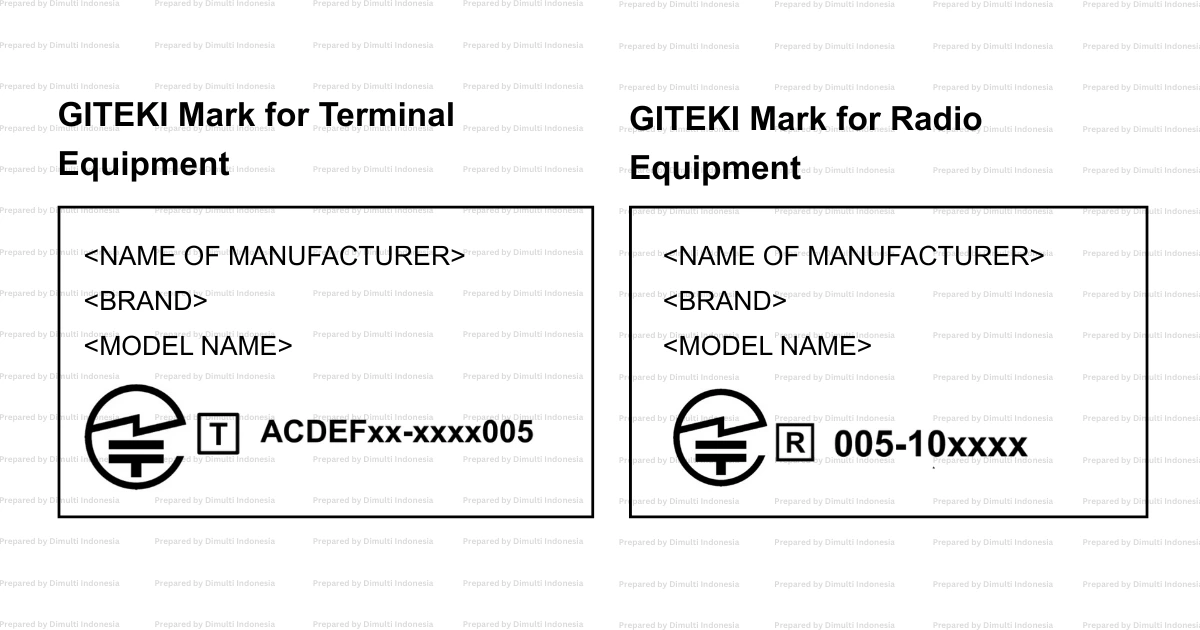
- GITEKI logo
- T = Terminal
- ACDEF = Device type; xx = certification year; xxxx = CB certificate number; 005 = ID number of CB
- R = Radio
- 005 = ID number of CB; 10 = certification year; xxxx = CB certificate number
Equipment under High Frequency Device (HFD) and Extremely Low-Power Device (ELP) categories also need to affix label after the MIC certification completed. Below is the marking format for a type approved equipment under HFD and ELP categories.
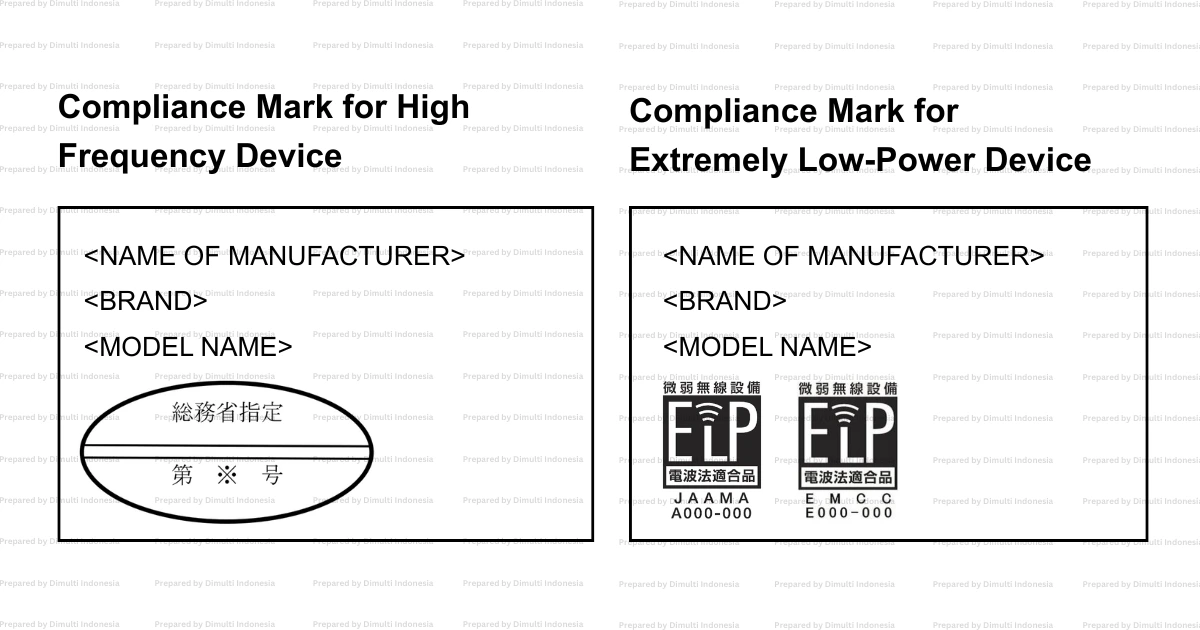
GITEKI mark and certificate number need to be affixed on the radio equipment. If it is not possible to do labelling on the radio equipment due to space limitation, then GITEKI mark and certification number may be affixed on user manual. For radio equipment with built-in display, the conformity label can be displayed as electronic label (e-label).
Validity of MIC Certification
The validity of Japan MIC certificates is indefinite. However, if there is any modifications on the RF feature of the radio equipment, then manufacturers need to apply for a new testing and certification. Modification on the RF feature may affect the product compliance to technical standards established by MIC.
Example of MIC Certification
Since the MIC certificates are issued by designated Certification Bodies (CB), then the certificate format may vary for each CB. For more details, you may check the following example of the issued MIC certificate.
Conclusion
Navigating Japan type approval certification is not easy, there are many things we need to know before starting the whole process. Usually, some manufacturers face difficulty to navigate Japan type approval due to knowledge limitation and language barriers to the whole type approval process in Japan.
To avoid these issues happening, the existence of a type approval service partner is important for manufacturers. You can consult with our expert team about Japan MIC certification drop an email to info@narmadi.com for further assistance.